
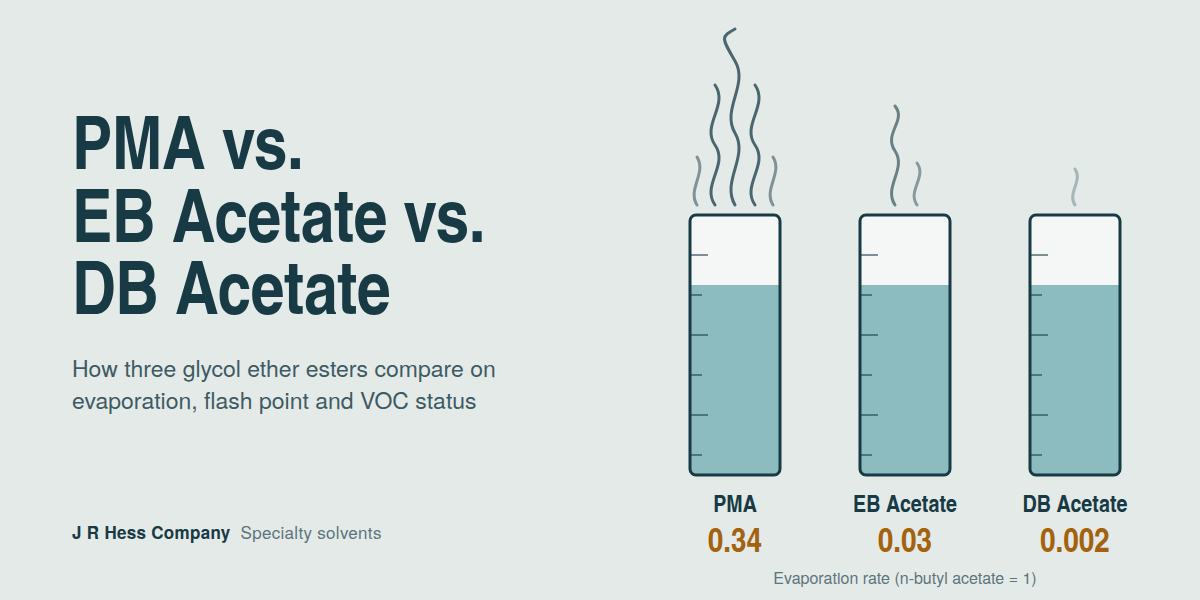
Propylene glycol methyl ether acetate (PMA), ethylene glycol butyl ether acetate (EB Acetate), and diethylene glycol butyl ether acetate (DB Acetate) are glycol ether esters used in coatings, inks, and other formulations. All three dissolve nitrocellulose, and all three appear in coating and ink applications. They differ considerably in evaporation rate, flash point, water solubility, and VOC exemption status. This guide compares their typical properties and applications.
Sourcing PMA, EB Acetate, or DB Acetate in the Northeast?
J R Hess can provide technical data, SDS documents, and pricing for glycol ether esters.
Request a QuoteSide-by-Side Typical Properties
| Property | PMA | EB Acetate | DB Acetate |
|---|---|---|---|
| Chemical name | 1-Methoxy-2-propanol acetate | Ethylene glycol monobutyl ether acetate | Diethylene glycol monobutyl ether acetate |
| CAS number | 108-65-6 | 112-07-2 | 124-17-4 |
| Empirical formula | C₆H₁₂O₃ | C₈H₁₆O₃ | C₁₀H₂₀O₄ |
| Molecular weight | 132.2 | 160.2 | 204.3 |
| Boiling range @ 760 mmHg | 140–150 °C (284–302 °F) | 186–194 °C (367–381 °F) | 235–250 °C (455–482 °F) |
| Evaporation rate (n-BuAc = 1) | 0.34 | 0.03 | 0.002 |
| Flash point (Tag closed cup) | 47 °C (116 °F) | 71 °C (160 °F) | 105 °C (221 °F) |
| Autoignition temperature | 272 °C (522 °F) | 340 °C (645 °F) | 249 °C (480 °F) |
| Vapor pressure @ 20 °C | 2.8 mmHg | 0.29 mmHg | 0.04 mmHg |
| Solubility in water @ 20 °C | 18 wt% | 1.1 wt% | 6.5 wt% |
| Water in solvent @ 20 °C | 6 wt% | 1.6 wt% | 3.7 wt% |
| Specific gravity (20/20 °C) | 0.969 | 0.941 | 0.98 |
| Weight per gallon | 8.0 lb | 7.84 lb | 8.16 lb |
| Viscosity | 1.1 cP | 1.8 cP | 3.2 cP |
| Surface tension | 27 dynes/cm | 30.3 dynes/cm | 30 dynes/cm |
| Freezing point | — | −64 °C (−83 °F) | −32 °C (−26 °F) |
| Blush resistance @ 80 °F | — | 95% RH | 96% RH |
| Maximum Incremental Reactivity (g O₃/g) | 1.63 | 1.52 | 1.29 |
| Federal VOC status | VOC | VOC | VOC |
| CARB LVP-VOC exempt (consumer products) | No | No | Yes |
PMA
PMA is a colorless, low-toxicity liquid with a characteristic ester odor. It is a propylene glycol ether acetate with excellent solvency for acrylic, nitrocellulose, and urethane coating resins. It is positioned as a substitute for certain ethylene glycol (E-series) ether acetates, particularly EEA and EMA. In an acrylic-epoxy baking enamel, PMA has a similar evaporation rate and solvency to EEA and has been found to give better gloss and image distinction.
Applications:
- Coatings. PMA is used extensively in decorative and protective coatings.
- Solvent-based cleaning. It is being evaluated, alone or with other solvents, as a replacement for chlorinated solvents in metal degreasing and specialized equipment cleaning. Its solvency matches that of chlorinated solvents more closely than glycol ethers and alcohols do.
- Electronics. PMA has replaced EEA in positive photoresist formulations for semiconductor processing, and it can be used to clean and degrease circuit boards and remove solder flux.
- Other uses. Agricultural, cosmetic, ink, textile, and adhesive products.
For very alkaline water-based cleaners, propylene glycol ethers are generally recommended over their acetates, because acetates can hydrolyze in those conditions.
EB Acetate
EB Acetate is a high-boiling glycol ether ester. Its slow evaporation rate provides excellent flow and leveling in high-bake coatings and in air-dry systems such as epoxy coatings. It has limited water miscibility and is supplied as a urethane-grade solvent. It is also listed as an inert ingredient permitted in nonfood-use pesticide products under FIFRA.
Its key attributes are efficient coalescence, excellent solvent activity, high blush resistance, high electrical resistance, ready biodegradability, and a slow evaporation rate. Applications include auto OEM and auto refinish coatings, commercial printing inks, general industrial coatings, and paints and coatings.
DB Acetate
DB Acetate is a high-boiling glycol ether ester and the slowest-evaporating of the three. It is widely used in printing inks, in high-bake enamels, and as a coalescing aid in low-pH latex paints. It is especially useful in screen inks and as a retarder solvent in coil coatings. It is also used as a selective solvent for separating alcohols and ketones by distillation.
DB Acetate shares EB Acetate’s key attributes: efficient coalescence, excellent solvent activity, high blush resistance, high electrical resistance, ready biodegradability, and a slow evaporation rate. It is also the only one of the three that is exempt as an LVP-VOC under CARB’s consumer products rules. It has the highest flash point of the three (105 °C / 221 °F) and the lowest Maximum Incremental Reactivity.
Handling Notes for PMA
- Storage. General industry practice is to store PMA in carbon steel vessels. Properly lined steel or stainless steel avoids slight discoloration from mild steel. Avoid contact with air during long-term storage, since the product can absorb water. Glycol ethers should never be stored or handled in copper or copper alloys.
- Fire precautions. Keep containers tightly closed and properly vented, away from heat, sparks, open flames, and strong oxidizers. Use non-sparking tools and ground containers before transfer.
- Materials. Stainless steel is recommended for valves, pumps, and filters, and Teflon is suitable for gaskets. Buna N, butylene polymers, and neoprene swell in contact with PMA.
- Hazard ratings. PMA is classified as a flammable liquid under SARA Title III, Section 311/312, but is not subject to SARA 313 reporting. Its hazard ratings are HMIS 2/2/1 (Health/Flammability/Reactivity) and NFPA 0/2/0.
For all three solvents, review the applicable Safety Data Sheet before handling.
Which One Should You Choose?
PMA: Consider it for coatings, electronics (photoresists, circuit board cleaning), and solvent-based cleaning, or as a replacement for EEA or EMA. It has the fastest evaporation and the highest water solubility of the three.
EB Acetate: Consider it when you need flow and leveling in high-bake or air-dry coatings such as epoxies, blush resistance, or a urethane-grade solvent.
DB Acetate: Consider it when you need the slowest evaporation, as in screen inks, retarders for coil coatings, and coalescing aids in low-pH latex paints, or when you need a solvent that is LVP-VOC exempt for California consumer products.
Talk to J R Hess
J R Hess Company has supplied specialty solvents to manufacturers since 1969. Our team can provide technical data, SDS documents, and pricing for glycol ether esters.